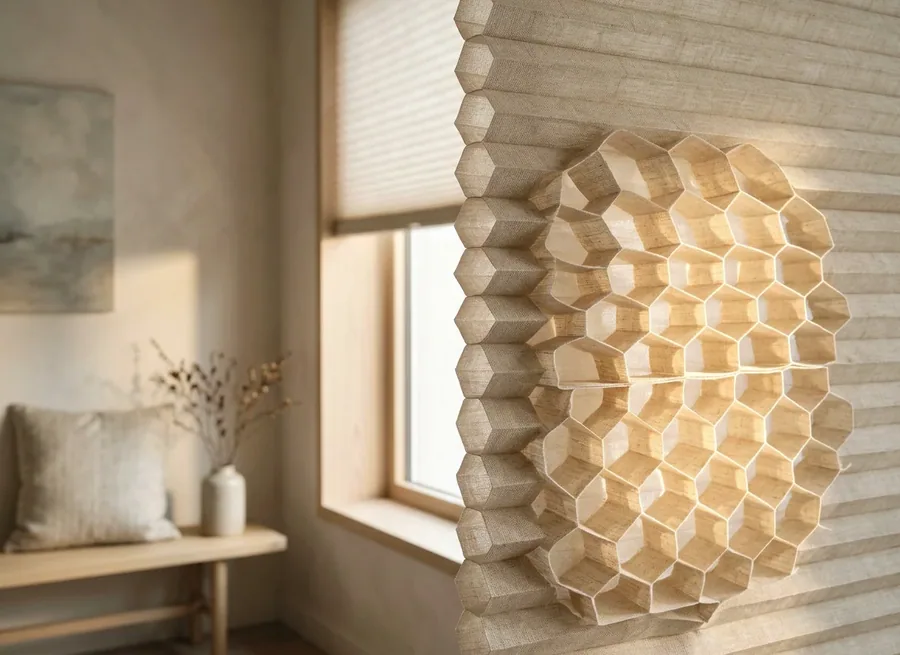
The cell is the technology: still air trapped against the glass, working in both directions.
A cellular blind is folded so that the fabric forms rows of honeycomb cells in section. Each cell traps a pocket of still air against the glass, and still air is a genuinely good insulator. Single, double and even triple-cell constructions exist; the more cells, the more insulating value and the deeper the stack when it is raised.
On the highveld that matters in both directions. The February afternoon that turns a west-facing room into a furnace, and the dry July morning where the same room is colder than the hallway, are the same problem seen from two ends. A cellular blind is the fabric answer to both.
In Sandhurst homes they earn their keep most often on high gable glass, skylights and double-volume windows — exactly the places you cannot reach, which is why they are so often motorised, and exactly the places where heat gain and heat loss are worst.
Practical notes
- Single and double-cell constructions; blockout and light-filtering fabrics.
- Top-down / bottom-up operation where you want light high and privacy low.
- Side channels or tensioned wires for skylights and sloped openings.
- A sensible pairing with motorisation, since the best windows for them are the hardest to reach.
Often specified together