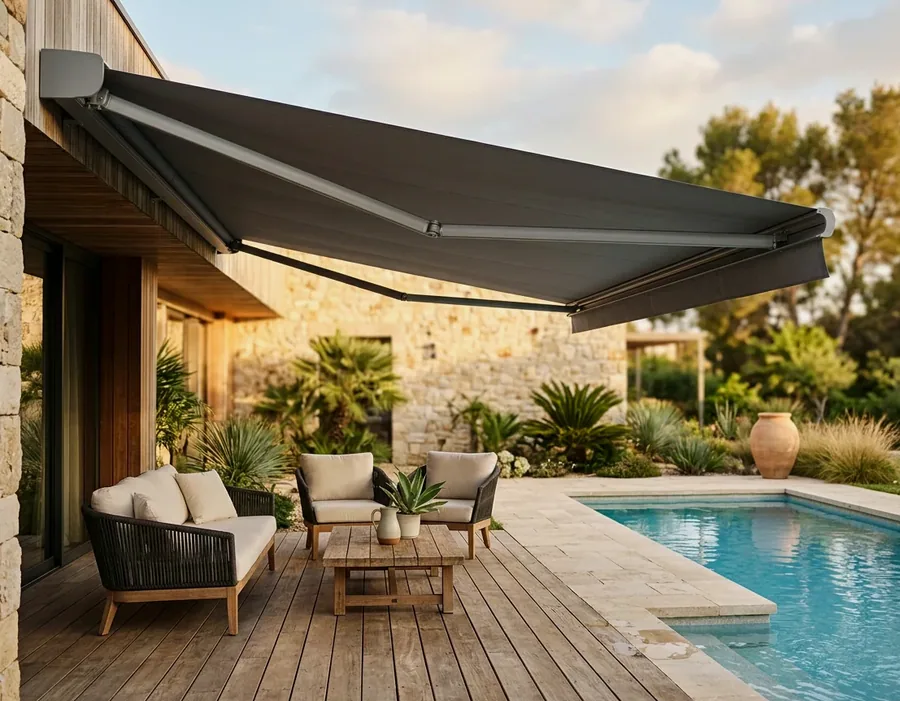
No posts, no footings — the arms carry the canopy, and the whole thing folds back to the wall.
A folding-arm awning is a fabric canopy carried on articulated arms that fold back against the wall when it is retracted. Because there are no posts and no footings, the terrace stays open — you can move furniture, lay a table for twelve, or leave the space empty, and nothing is in the way.
Typical projection runs to about 3.5 metres on a domestic installation, which is usually enough to shade a dining table from around two in the afternoon. The fabric is a solution-dyed acrylic that holds its colour in highveld UV, and the frame is powder-coated aluminium.
Wind is what kills awnings on the highveld, not rain. On any exposed Sandhurst elevation we fit a wind sensor as standard so the awning retracts itself before a gust or a hailstorm arrives, whether or not anybody is home. A full cassette — a closed housing that seals fabric and arms away when retracted — is worth the extra on a dusty or exposed site.
Practical notes
- Projections to roughly 3.5m; wider runs coupled where the wall allows.
- Solution-dyed acrylic canopies in plain and striped patterns.
- Motorised with remote and wind sensor as standard on exposed elevations.
- Full cassette housings to seal fabric and arms away when retracted.
Often specified together